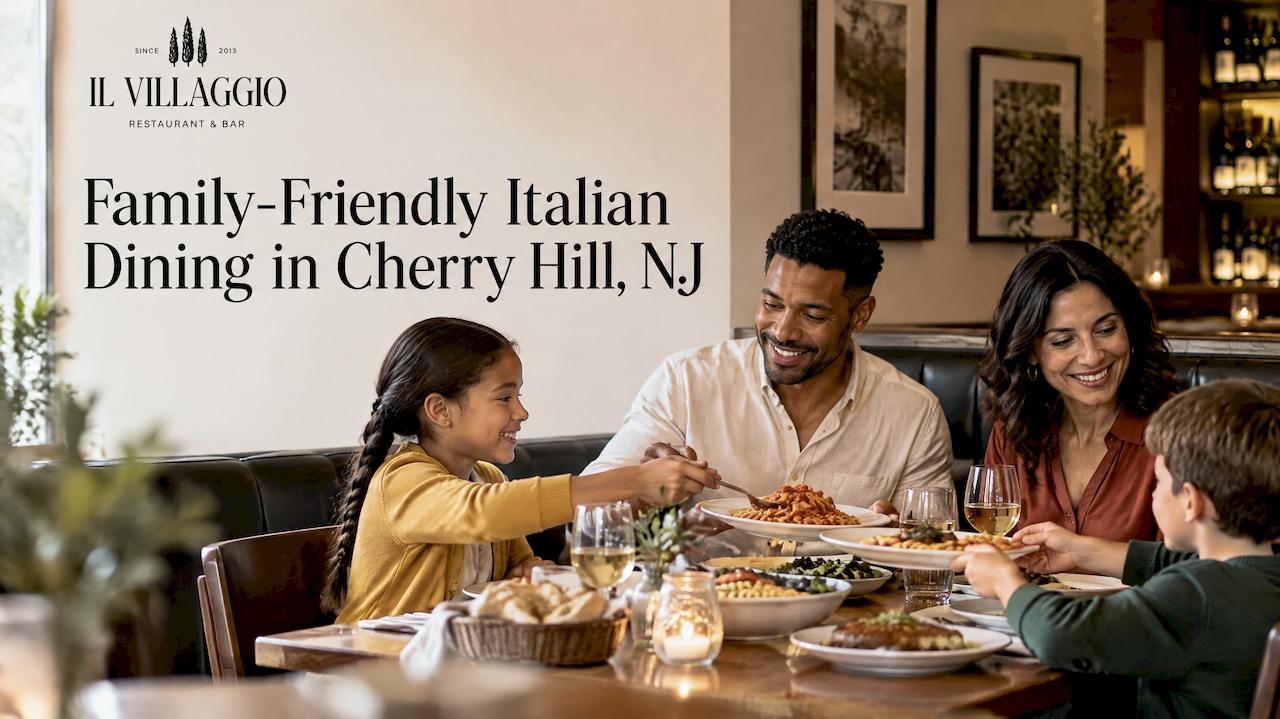
The best family-friendly Italian dining is a table where children are welcome, the food arrives without a long wait, and the whole group can share what is on the plates. At Il Villaggio, a family-owned scratch kitchen in Cherry Hill since 2013, handmade pastas and a warm, home-like dining room make that kind of evening easy, whether it is a Tuesday supper or a birthday for twenty.
Below, we explain what families should look for, what "family style" actually means, which Italian dishes work for mixed ages, and how to plan a meal so everyone, from toddlers to grandparents, leaves happy.
TL;DR
- Family-friendly means short waits, sturdy tableware, a kids' menu with real food, and a room where a little noise is welcome.
- Family style means food comes in large bowls and platters, and the table passes and shares it, much like dinner at home.
- Pasta, lasagna, gnocchi and cutlets please both children and adults, and sharing lets everyone try more.
- For birthdays, showers and bigger groups, a private room with a set menu keeps the evening calm and the cost clear.
- Il Villaggio hosts private groups of roughly 15 to 240 guests, and everyday family dinners in our dining rooms.
Table of Contents
- What makes an Italian restaurant family-friendly
- What "family style" dining means
- Family style versus ordering individual plates
- Italian dishes that work for mixed ages
- How to plan a relaxed meal with kids
- Family dinner in Cherry Hill and South Jersey
- Celebrations, showers and larger groups
- Your table at Il Villaggio
- Our view: a family table is a shared table
- FAQ
- Sources
What makes an Italian restaurant family-friendly
A friendly greeting and a crayon are nice, but they are not what makes a restaurant work for a family. Children have a short window between hungry and unhappy, and parents are watching the clock as much as the menu.
An Italian food magazine, La Cucina Italiana, summarized what a family-friendly restaurant should offer: shorter waits for a table and for service, high chairs, unbreakable tableware, child-sized cutlery, baby-changing facilities, and kids' menus at a moderate price. That is a good checklist to carry with you, and it is worth calling ahead about any item that matters to your family.
The same article quotes chef Antonino Borghese, who says a children's menu can include indulgent favorites such as gnocchi in tomato sauce or a cutlet with fries, as long as the ingredients are of top quality. We agree with the spirit of that. Children should not get a lesser kitchen. They deserve the same care as the adults at the table.
The small things parents notice
Beyond the checklist, families tend to judge a restaurant on a handful of everyday details:
- Whether the first thing on the table arrives quickly, such as bread, so hungry kids settle.
- Whether a table can be set up for a stroller, a high chair or a grandparent who needs an easy seat.
- Whether the staff treats a spilled drink as no big deal.
- Whether the menu has something simple for a picky eater without making the adults compromise.
Italian cooking happens to suit all four. Pasta with tomato sauce, butter or cheese is a natural starting point for a child, and the same kitchen can send out a rich ragu, fresh seafood or a premium cut of meat for the grown-ups.
What "family style" dining means
People searching for family-friendly Italian dining often run into a second phrase: family style. It sounds like it means "good for kids," but it describes how the food is served.
The Cambridge English Dictionary defines family-style as food brought to the table in large dishes so that people can serve themselves. A dining-room management textbook from Nicolet College describes the same service: food in large portions on platters or bowls, shared by the guests, and common in Italian, Chinese and Middle Eastern restaurants, often for groups.
A food-service course published by LibreTexts adds that servers deliver the ordered food and the guests pass items around the table, creating an experience closer to dinner at home than a typical restaurant meal.
In plain terms, nobody gets a single plate that is theirs alone. The table orders several dishes, a big bowl of pasta lands in the middle, and everyone fills their own plate.

Why it suits families
Sharing is how many Italian families have always eaten, and it solves several problems at once.
Children can try new things safely. A spoonful of something unfamiliar on a plate full of something they love is a low-pressure experiment. Nobody has to commit to a whole entree they might refuse.
Adults are not stuck with one choice. Instead of each person deciding on one dish and hoping, the table gets to taste several.
The meal starts talking. Choosing what to share, passing the bowl and offering seconds turn dinner into something the whole table does together, rather than five people looking at five separate plates.
Portions flex. The Nicolet textbook points out that family-style service makes it easier to accommodate varying group sizes. A hungry teenager takes more, a toddler takes a little, and nothing is wasted on a plate that was too big.
What to watch for
Shared platters need a little attention at the table. The same textbook notes that the main considerations are portion uncertainty, pace and individual dietary needs and allergens. If anyone in your party has a food allergy, tell your server before ordering, and keep that person's plate and serving spoons separate. With a child who has an allergy, speak to the manager or chef directly and ask how the dish is prepared. That conversation is a normal, welcome part of a family dinner, and we are glad to have it.
Family style versus ordering individual plates
Neither approach is wrong, and many tables mix them: a few shared starters, then individual main courses, then one dessert with several forks.
Individually plated meals are best when family members want very different things, when someone has a strict dietary need, or when you are running short on time before a show or a game. Shared dishes are best when you have a group, an occasion, or children who are likely to graze rather than finish a plate.
A simple rule that works well for a family of four or more: order one shared starter, one or two pastas for the table, one main course that suits the adults, and let the kids fill up on pasta first. You can always add a dish. It is harder to take one back.
Italian dishes that work for mixed ages
Italian food for kids does not have to be a separate, simplified menu. Many classic dishes are already gentle enough for children and interesting enough for adults.
Pasta and baked dishes
Fresh, handmade pasta is the safest crowd-pleaser, because the texture is soft and the sauces can be as simple or as layered as you like. We make our pastas by hand in-house, and a table that shares two or three shapes and sauces gets a small tour of what a scratch kitchen can do.
A food site, Tasting Table, lists sausage and ricotta lasagna among the easiest ways to feed a group, and notes it is best rested before cutting so it holds together. It also suggests caprese salad, risotto and tiramisu as shareable family-style classics. Those are the dishes that make a whole table go quiet for a moment, which is the best compliment a kitchen can get.
Something for the adults, too
While children take the pasta, adults often want something with more depth. Our menus feature fresh seafood from Long Beach Island when it is in season and premium domestic meats, all prepared in-house daily. If you are curious how to recognize quality seafood, our guide to spotting a truly fresh seafood restaurant walks through it. You can look over the current offerings on the dinner menu or the lunch menu before you come, which helps picky eaters know what to expect.
Wine and drinks
Family dinners do not have to be dry. A bottle of wine for the grown-ups pairs naturally with a shared pasta course, and a guide on matching wine with pasta by sauce shows how a tomato sauce, a cream sauce and a meat ragu each call for something different. Our Italian food and wine pairing guide covers every course, and our full bar and curated wine list are there when the kids are finally full and the adults want to linger. You can see the bar menu ahead of time.

How to plan a relaxed meal with kids
A little planning turns a hectic dinner into a pleasant one. These habits come up again and again for families who enjoy eating out.
Pick the right hour. Early evening and weekday dinners tend to be calmer than a Saturday at 7 p.m. If your children are young, aim for a seating that lines up with their usual dinnertime rather than testing their patience.
Reserve and mention who is coming. Tell the restaurant how many adults and children will be in the party, and whether you need a high chair or extra room for a stroller. A table that is ready when you walk in removes the most stressful part of the evening.
Order the first thing fast. Bread, a shared appetizer or a bowl of pasta for the table gives children something to do and something to eat while the rest of the order is being prepared.
Let the meal pace itself. The traditional Italian progression goes from antipasti to pasta, then the main course, then side dishes and dessert. You do not need every course. For a family, a starter and a pasta course shared across the table often covers everyone, with an entree or two for the adults and one dessert to split.
Keep a plan for restless moments. A short walk to the door, a quick look at the photos of the dining room, or a few minutes standing with a toddler is part of eating out with small children. A relaxed room and a patient staff make those moments easier. You can take a look at the dining spaces in our photo gallery before you visit.

Family dinner in Cherry Hill and South Jersey
Families from Cherry Hill, Haddonfield, Voorhees, Mount Laurel and across Camden County have different reasons to go out for Italian: a school achievement, a grandparent visiting, a weeknight when no one wants to cook. What they share is a wish for a restaurant that feels like an extension of home.
That is the kind of room we set out to build when we opened in 2013. We are a family-owned restaurant, and many of the people who cook and serve here treat guests the way they would treat relatives at their own table. If you are planning a dinner with friends rather than a family night, our notes on dinner with friends in Cherry Hill cover that case, too.
Celebrations, showers and larger groups
Family-style eating comes into its own when the table gets big. A birthday for fifteen, a baby shower, a graduation or a multigenerational holiday meal is much easier when the food is shared and the room is yours.
Our private spaces host groups of roughly 15 to 240 people, from small celebrations to corporate gatherings. A few things make larger family events go smoothly:
- Settle the headcount and the date early, and tell us about any allergies or dietary needs in the group.
- Choose a set menu so the cost per guest is clear before the day arrives.
- Decide how the food should be served, whether passed, shared or plated, based on the ages in the room.
- Plan the toasts and the cake so the meal is not rushed.
Our large group dining guide explains how to book and plan, and the private events page shows the rooms.
What a private event menu costs
Our published event menus start at $36 with Event Menu 1. Event Menu 2 is $51 and Event Menu 3 is $63. The Elegant Cocktail Reception is $51 per person, and the Signature Cocktail Reception is $63. For something more special, the Chef's Menu is $98 and the 7-Course Wedding Menu is $125. For events at your own location, we also offer full-service catering. Prices were read from our site on October 31, 2026, so check the pages for the latest.
If your gathering is a company lunch rather than a family party, our guides to a business lunch restaurant and a corporate event venue are written for that.
Your table at Il Villaggio
For an everyday family dinner, come as you are. We are a scratch kitchen with handmade pastas, seasonal seafood from Long Beach Island and premium domestic meats, a full bar and a welcoming dining room. For a birthday, shower or any gathering of 15 or more, our private rooms keep the evening yours.

Look over the dinner menu, then visit Il Villaggio in Cherry Hill to plan your table or your event. Gift cards are available too, for the family that deserves a night out.
Our view: a family table is a shared table
We grew up believing that the best meals are the ones where the bowl is passed and nobody is counting who took the last meatball. That is how we cook, and it is how we want our dining rooms to feel.
A family-friendly restaurant is not about novelty menus or a pile of crayons. It is about care in the kitchen and patience in the room. Everything here is made from scratch, in-house, every day, and that includes the pastas, because children and grandparents can both tell when pasta was made by hand.
So we encourage families to share. Order a few things for the middle of the table, let the little ones fill up on pasta, and let the adults enjoy the seafood or the meats. When the evening is a celebration, our private rooms give you space for everyone you love, from a handful of guests to a few hundred.
Come hungry, bring the whole family, and let us make the table feel like home.
Jay Mar
FAQ
What does family style dining mean?
Family style means the food is brought to the table in large bowls or platters, and guests pass the dishes and serve themselves. The Cambridge English Dictionary describes it that way. It is common in Italian restaurants and works especially well for groups.
What Italian food do kids usually enjoy?
Simple pasta with tomato sauce, butter or cheese, gnocchi, cutlets and lasagna are reliable choices. Chef Antonino Borghese told La Cucina Italiana that favorites like these are fine on a kids' menu when the ingredients are excellent.
Is Italian a good choice for large groups?
Yes. Pasta, baked dishes and shared starters are easy to pass around a long table, and portions can stretch to fit different appetites. At Il Villaggio, private groups of roughly 15 to 240 guests can reserve a room and choose from set event menus.
How do I handle allergies at a shared table?
Tell your server or the manager before you order, and ask how the dish is prepared. Keep serving spoons separate for the person with the allergy. Shared platters can make allergens harder to track, which is why a quick conversation at the start of the meal matters.
Sources
- FAMILY-STYLE definition, Cambridge English Dictionary
- Chapter 7 Contemporary and Casual Service Styles, Nicolet College
- Lesson 6.1: Managing Guest Services, LibreTexts
- Bambini al ristorante: come essere davvero family friendly, La Cucina Italiana
- The Best Family-Style Italian Recipes And Dinner Ideas, Tasting Table
- Match Wine With Pasta by Sauce