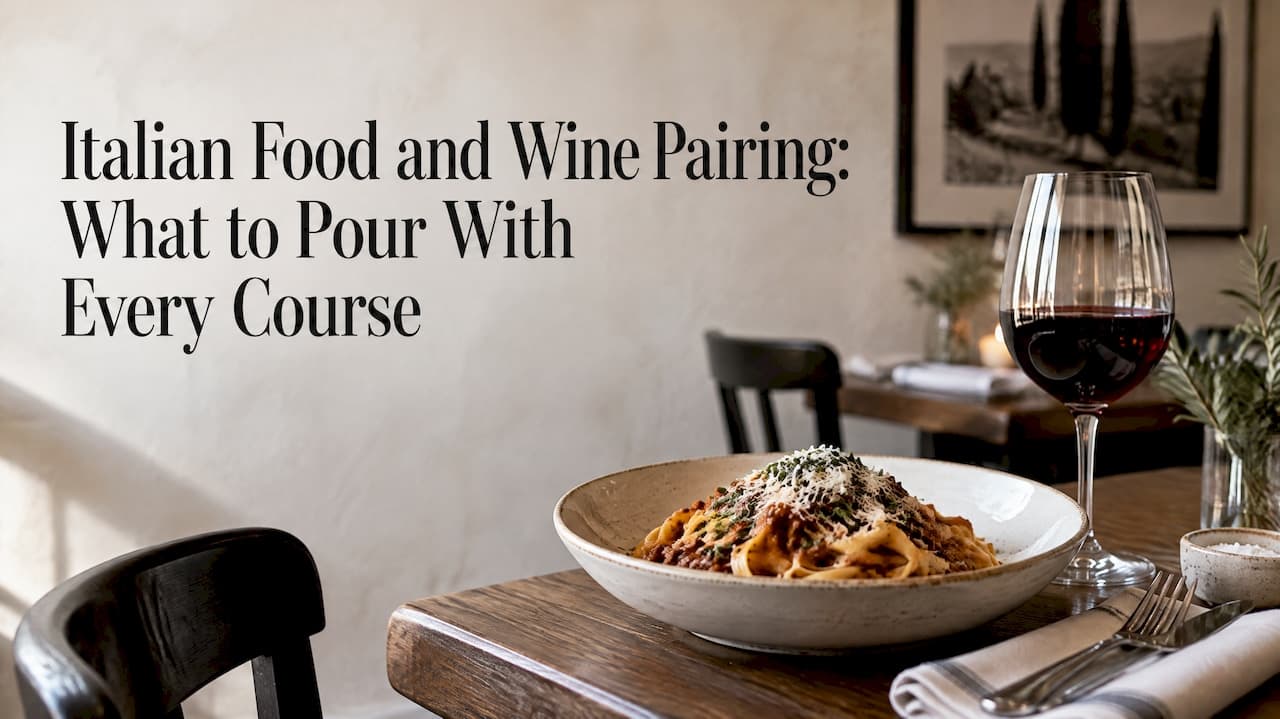
The best wine for Italian food is the one that matches the sauce, not the pasta shape. Think Chianti or Barbera with tomato and ragù, Vermentino or Pinot Grigio with seafood and pesto, sparkling wine with fried starters, and a structured red such as Barolo with steak or braises. Below you will find the rules behind those matches, course-by-course picks, and a few ways to order with confidence at the table.
TL;DR
- Match the wine to the dominant element of the dish, which is usually the sauce, then match weight: light dishes get light wines, rich dishes get fuller ones.
- Tomato dishes like high-acid, lower-tannin reds (Chianti, Barbera). Seafood, pesto and cream sauces like crisp or herbal whites (Vermentino, Pinot Grigio, Gavi).
- Salt, fat and acidity change how a wine tastes, so use them: bubbles cut through fried food, tannin loves rich meat.
- Start with a wine you actually enjoy. A textbook match you dislike is still a bad match.
- Not sure? Ask your server for a glass pour of two candidates and compare them with the food.
Table of Contents
- Four ideas that make every pairing easier
- Wine with Italian pasta, sauce by sauce
- Antipasti, fried starters and seafood
- Steak, braises, ragù and hearty mains
- Dessert
- Perspective: why a scratch kitchen makes pairing easier
- Ordering at the table: a simple routine
- Spicy, fried and unusual dishes
- Planning wine for a group or private event
- Plan your next Italian dinner with us
- FAQ
- Sources
Four ideas that make every pairing easier
You do not need to memorize a chart. A handful of principles cover most of an Italian menu.
Begin with a wine you like. The Wine & Spirit Education Trust's guide to food and wine matching starts with this point: a conventionally perfect match is unlikely to please you if you dislike the wine. The same guide tells you to consider how salt, acidity and fat change the taste of the wine, and to trust your palate.
Match the sauce, then the weight. Wine Spectator's pasta guide says the sauce is usually the dominant element, and that the wine's weight should broadly follow the dish's richness, whether that comes from fat, ingredients, cooking method or sauce. A cream sauce and a bright tomato sauce ask very different things of a glass.
Choose contrast or concordance. Contrast sets opposites against each other: freshness or bubbles against fattiness, tannin against oily textures. Concordance matches intensity and aroma, so a delicate dish gets a delicate wine. Both approaches are described in this overview of food and wine pairing.
Let geography help. Italian dishes and wines grew up in the same regions, so a local pairing is often a safe first guess. Seafood from the coast suits coastal whites, and a Tuscan steak suits a Tuscan red. Banfi's account of the Italian Sommelier Association's method calls this the tradition approach.
Wine with Italian pasta, sauce by sauce
Pasta is where most people start, and the sauce decides everything. Here is how the common ones break down.
| Sauce | Wine styles that work | Why |
|---|---|---|
| Tomato (marinara, pomodoro) | Chianti, Barbera, Dolcetto, Montepulciano | High acidity and modest tannin meet the tomato's acidity |
| Meat ragù, baked pasta | Chianti Classico, Barbera, Montepulciano | Body and tannin stand up to meat and cheese |
| Cream (Alfredo-style) | Vermentino, Pinot Grigio, lightly oaked Chardonnay | Freshness cuts the richness without adding weight |
| Pesto | Vermentino | Herbal character and acidity suit basil, Parmesan, pine nuts and garlic |
| Seafood and clam sauces | Vermentino, Fiano, Falanghina, Pinot Grigio | Crisp, light to medium whites keep the sea flavors clear |
Tomato sauce
Wine Spectator pairs Chianti with tomato sauce, and the same piece suggests Vermentino for creamy Alfredo. Food & Wine explains why: tomato pairing starts with matching acidity, while allowing for the sauce's sweetness and depth. Its advice is to avoid tannic, full-bodied, oaky reds, which can taste harsh next to tomato. Its list of high-acid, lower-tannin Italian options includes Barbera, Dolcetto, Teroldego from Alto Adige, Pinot Nero, Schiava, Chianti Classico and Etna reds, and it suggests dry Lambrusco for pizza.
If your table is sharing a few pastas, a bottle of Barbera or Chianti Classico is a forgiving all-rounder.
Pesto and green sauces
Decanter recommends Vermentino from Colli di Luni with pesto, because its herbal edge, weight and acidity suit basil, Parmesan, pine nuts and garlic. The same guide advises light- to mid-weight wines with good fruit and acid balance for pasta in general, and warns that bold, very oaky wines can overpower a sauce.
Light, simple sauces
Sauce matters more than shape. Fiona Beckett's pasta guide in The Guardian pairs a light dish of courgette, pancetta and pecorino with a fresh white such as Orvieto or Verdicchio, while an oxtail rigatoni calls for Barbera or Nero d'Avola. Same pasta family, two very different glasses.
Seafood pasta
For seafood pasta, Wine Spectator points to refreshing light- to medium-bodied whites such as Pinot Grigio, Friulano or Pinot Bianco. Spaghetti with clams is a classic partner for Vermentino, Fiano or Falanghina, a combination that runs through most Italian coastal cooking.

Antipasti, fried starters and seafood
Lighter food wants lighter, crisper wine. That is the simplest rule for the start of a meal.
- Prosciutto and cured meats: crisp Pinot Grigio, dry Prosecco or light Bardolino. Heavy tannic reds can overwhelm the delicate salty flavor of Prosciutto di Parma.
- Fried starters such as arancini or calamari: sparkling wine such as Franciacorta or Prosecco. The bubbles and acidity reset your palate between bites, a textbook case of contrast.
- Bitter greens and vegetable sides: Decanter suggests Gavi or Bardolino with bitter-leaf sides, and says lighter Pinot styles or Gamay can work when the side has no astringency, served cool.
- Shellfish and fish: the classic matches are cool, high-acid whites. Jancis Robinson's food-matching guide lists Albariño with clams and grilled sardines, Chablis or Muscadet with oysters, Pinot Gris with mussels, and Chablis with scallops. The same page pairs salmon with Pinot Noir or Chardonnay from New Zealand, and lobster with Meursault.
The point for an Italian menu: you are not locked into Italian bottles. Muscadet or Champagne with oysters, or Albariño, Gavi or Chablis with shellfish, all follow the same logic of freshness against brine. WSET lists these among its shellfish examples.
Steak, braises, ragù and hearty mains
Rich meat dishes need a wine with matching body and tannin. Tannin feels astringent on its own, but fat and protein soften it, which is why a big red and a well-cooked steak flatter each other.
Jancis Robinson's guide pairs steak with tannic reds such as Brunello di Montalcino or Barolo, alongside Pauillac, Ribera del Duero or young Cabernet Sauvignon. It matches lamb chops with Ribera del Duero or Rioja, and lamb shanks with Hermitage, Côte Rôtie or Syrah.
Here is a practical way to apply that on an Italian menu:
- Grilled or roasted red meat: go for the structured end, Barolo, Brunello or a Super Tuscan style blend.
- Slow braises and ragù: choose a medium-to-full red with acidity, such as Chianti Classico or Barbera, so the sauce does not feel heavy.
- Veal or chicken in lighter sauces: step down in weight to a medium red or a fuller white.
- Aged hard cheese at the end: it can take a structured red. Keep the glass you had with the main course.
Dessert
Sweet dishes need a wine at least as sweet as the dessert. A dry wine tastes bitter next to sugar. For tiramisu, WSJ Wine suggests sweet fortified Marsala or Vin Santo, with Cream Sherry or Australian Liqueur Muscat as alternatives, and warns that dry wine can taste bitter with it. A cocktail made with espresso or amaro is another route if wine is not your thing at the end of the night.
Perspective: why a scratch kitchen makes pairing easier
In our kitchen almost everything is made in-house daily: the pastas by hand, the sauces from scratch, and the seafood from Long Beach Island when it is in season. That matters for pairing, because when a sauce is built from real ingredients its character is clear: bright acidity in the tomato, sweetness in a slow braise, salt and brine in the seafood.
When guests ask us what to order with their pasta, we start with the sauce and the weight, just as the guides above do. Then we ask what they like to drink. A Chianti lover will be happy with our red-sauce dishes. Someone who prefers crisp whites will find plenty on the seafood side of the menu. Our team is glad to suggest a glass, and we encourage you to try two side by side.
We think the best pairing is the one that makes your table relax and talk. That is the kind of dinner we built Il Villaggio for.
Jay
Ordering at the table: a simple routine
You can apply all of this in about a minute.
- Pick the dishes first. Wine follows food. If you have ordered for the table, find the dominant sauce or protein.
- Say what you like. Tell your server whether you prefer light or bold, dry or fruity. This follows the first rule above.
- Choose by weight. If the table has mixed dishes, pick a medium-bodied, high-acid wine, which is the most flexible style. A Barbera or a Chianti Classico does well across tomato, ragù and many meat courses, and a crisp Italian white does well across seafood and starters.
- Order by the glass to test. Two glasses beat one wrong bottle.
- Match the finish. If dessert is sweet, order something sweeter than the plate.
You can look over our wine list and dinner menu before you come, and plan your pairings in advance. If you would rather start with a cocktail, our cocktail menu is worth a look too.
Spicy, fried and unusual dishes
A few cases trip people up.
Spicy dishes. Heat is amplified by alcohol and tannin. Vino Critic's guide suggests Moscato d'Asti, off-dry Prosecco, Lambrusco or chilled Dolcetto for spicy food. A little sweetness and a lower alcohol level calm the heat.
Fried food. Bubbles are the classic answer. The same guide pairs fried foods with Prosecco, Franciacorta, Lambrusco or Verdicchio.
Pizza. Pizza Margherita is a tomato dish at heart, so the tomato rules apply: Chianti or Sangiovese, or dry Lambrusco as Food & Wine suggests in its tomato-sauce guide.
Mixed tables. When one guest orders fish and another orders veal, go for the middle: a medium-bodied wine with good acidity and low tannin, such as a lighter Pinot Nero or a fresh Barbera. Or order one white and one red for the table.
Planning wine for a group or private event
Pairing becomes more fun when there is a group, because a table can try several styles. For a seated dinner, a good pattern is sparkling wine or a crisp white with the first course, a medium red or fuller white with the pasta, a structured red with the main, and a sweet wine or coffee at the end.
If you are planning a celebration, our event menus are built around that rhythm. Our Elegant Cocktail Reception is $51 per person, and our Chef's Menu is $98 and our 7-Course Wedding Menu is $125. Our rooms host private groups of roughly 15 to 240 people for celebrations, showers and corporate gatherings, and our team can talk through drink choices with you when you plan the menu.

Plan your next Italian dinner with us
Il Villaggio is a family-owned Italian restaurant in Cherry Hill, open since 2013. We make handmade pastas, serve seasonal seafood from Long Beach Island and premium domestic meats, and run a full bar with craft cocktails and a curated wine list. Whether it is a date night or a family dinner, we would love to pour you something that suits your plate.

See our dinner menu and book a table, or explore private events and private dining for a larger group.
FAQ
What wine goes best with Italian food in general?
There is no single answer, but a medium-bodied, high-acid wine is the most flexible choice. Chianti and Barbera suit tomato dishes and many meat courses, while Vermentino and Pinot Grigio suit seafood, pesto and lighter plates. Start from the sauce and your own taste.
Should I drink red or white with pasta?
Let the sauce decide, not the pasta. Tomato and meat sauces suit reds with good acidity, while cream, pesto and seafood sauces suit whites. As Wine Spectator notes, the sauce is usually the dominant element.
What wine goes with pizza?
Pizza usually carries tomato sauce, so pick a wine with matching acidity and modest tannin. Chianti, Sangiovese and Barbera are common choices, and dry Lambrusco is another option. Avoid heavily oaked, very tannic reds, which can taste harsh against tomato.
What wine goes with tiramisu or other Italian desserts?
Choose a wine that is sweet enough to match the dessert. Marsala and Vin Santo are the traditional Italian picks for tiramisu, and a dry wine can taste bitter beside it.
Do I have to drink Italian wine with Italian food?
No. Italian wines are a safe starting point because the food and wine developed together, but other wines work when they match the dish's weight and acidity. Albariño or Chablis with shellfish are examples, and your own palate has the final say.
Sources
- Wine food matching essentials, Wine & Spirit Education Trust
- Which Wines Pair Best with Pasta?, Wine Spectator
- Italian pasta and wine: the best pairings, Decanter
- Classic Italian dishes: wines to drink with them, Decanter
- Matching pasta and wine, Italian style, The Guardian
- The Best Wine With Pizza, Pasta, and Other Tomato Sauce Dishes, Food & Wine
- Food matching: food first, Jancis Robinson
- Wine and food pairing, Domini Castellare
- The art of pairing food and wine, Banfi
- Italian Food and Wine Pairing Guide, WSJ Wine
- Pairing Food With Italian Wine, Vino Critic