A fresh seafood restaurant is one that buys local catch in season, keeps a menu small enough to move product quickly, and can tell you where your fish came from without a pause. You can check all of that in the first ten minutes of a visit, and in South Jersey you have an advantage, because some of the best seafood in the Northeast is landed within a couple of hours of your table. Here is how we think about it at Il Villaggio, and how you can choose well wherever you dine.
TL;DR
- Freshness shows up in the details: a mild, briny smell, a concise menu, and staff who can name the source of the fish.
- Seasonal, local seafood beats a long menu of year-round everything. Ask what came in recently.
- In New Jersey, the season shapes the plate: fall brings swordfish, porgy and tuna, while clams and oysters are around all year.
- At Il Villaggio in Cherry Hill, we pair handmade pasta with fresh seafood from Long Beach Island when it is in season.
- Planning a group? Ask about menus, room size and timing early, and we will walk you through our private event options.
Table of Contents
- What actually makes seafood "fresh"
- Reading the menu before you order
- Questions worth asking your server
- What your senses and the thermometer tell you
- Why South Jersey is a good place to eat seafood
- How an Italian kitchen cooks seafood
- Choosing for date night or a family celebration
- Planning a group dinner or private event
- Our point of view
- Make a reservation or plan your event
- FAQ
- Sources
What actually makes seafood "fresh"
Menus love the word, but freshness is something you can observe rather than something you have to take on faith. Chefs who talk about this tend to agree on a few signals.
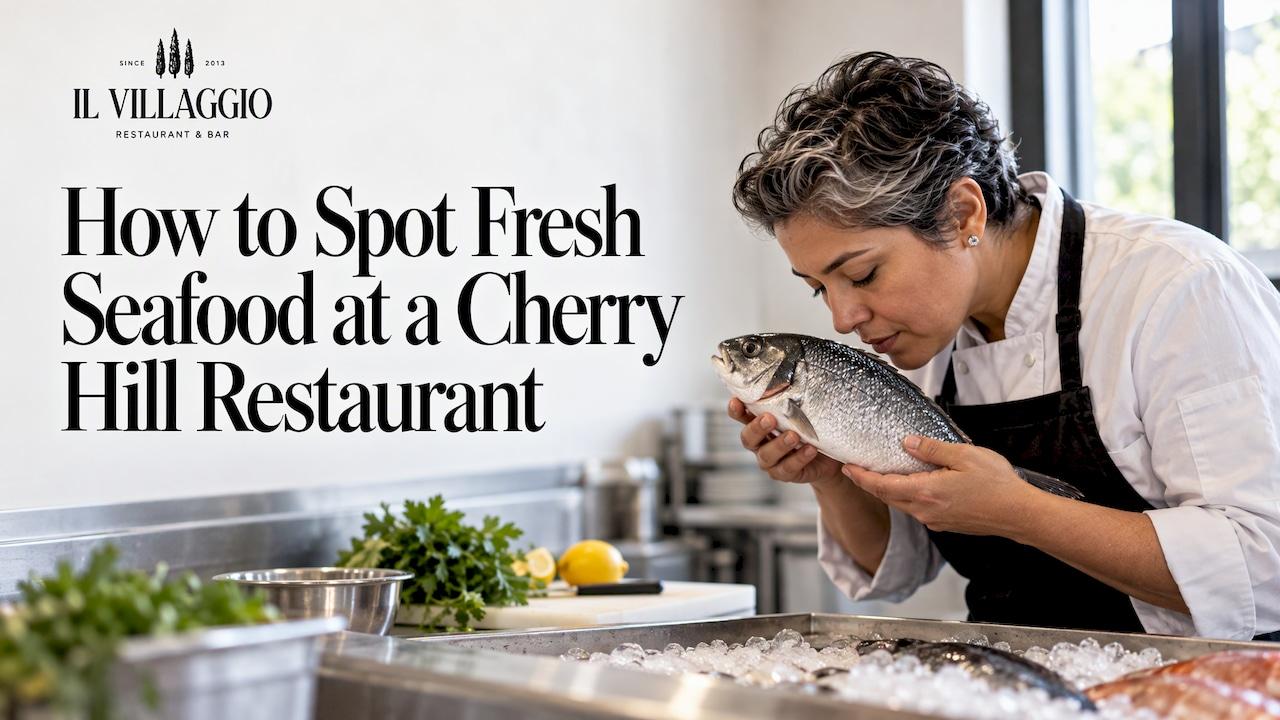
The first is the smell. Executive chef Alan Gosker told Tasting Table that a good seafood restaurant should smell like the ocean, slightly briny, and never fishy. An ammonia smell, he warns, points to spoiled fish. If the dining room greets you with that sharp odor, trust your nose.
The second is turnover. Chef Michael Nelson of GW Fins in New Orleans put it plainly to Eat This: serving fresh seafood means being busy and constantly turning over fresh product. A lively dining room is a good sign, because fish that moves fast does not sit.
The third is how far the fish had to travel. Executive chef Kory Foltz told Mashed that two things matter most: local seafood and a smaller, more concise menu. Local catches do not need to travel far, and a small menu pushes product through the kitchen quicker.
That last point is worth sitting with. A menu with fifty seafood items and no sense of season is hard to keep fresh. A menu with a handful of well-chosen dishes, built around what is good right now, is how a kitchen stays honest. It is the way we cook at Il Villaggio: a scratch kitchen, where pastas are made by hand and everything is prepared in-house daily, with seafood from Long Beach Island on the menu when it is in season.
Reading the menu before you order
You can learn a lot before anyone brings you water. Look for specifics. The Monterey Bay Fisheries Trust suggests watching for details such as the species, where it was caught, and who sourced it. A line that says only "fresh fish" tells you nothing. A line that names the fish and the place tells you the kitchen is paying attention.
The same organization notes that "market price" next to a fish often means the restaurant is buying whatever fresh fish is available locally. That is not a trick. It is usually a sign the kitchen is buying by the day, not by the contract.
Chef Owens, speaking to Business Insider, described a good seafood menu as one that reads like a tide chart: changing, seasonal, and perhaps a little unfamiliar. He also flagged one specific red flag: a prized, threatened fish like bluefin tuna showing up on the menu all year round. If something that should be seasonal never leaves the menu, it is fair to wonder how it is being sourced.
Seasonal does not mean limited. It means that the best thing on the plate in October is not the best thing in July, and a good kitchen cooks accordingly.
Questions worth asking your server
A confident restaurant welcomes questions about the fish. You are not being difficult; you are doing what the people who work in fisheries encourage. The Monterey Bay Fisheries Trust recommends asking whether the seafood is locally caught, what is in season, when it came in, and where the restaurant buys it. The NAMA Sustainable Seafood Guide offers the same advice in a nutshell: ask how, where, and when your fish was caught.
Tasting Table adds that a quality restaurant should have staff who can tell you about the origin and freshness of what they serve, along with a clean, organized dining area and kitchen and a posted health grade. When your server answers easily and with a little pride, that is the experience you are looking for.
There is a bigger reason to ask, too. The Monterey Bay Fisheries Trust points out that when diners show strong demand for local seafood, chefs are more likely to buy from local fishermen and label it on the menu. Your curiosity helps shape what the next table sees.
At our tables, we are happy to talk through what is on the menu and what is in season. Our dinner menu is the place to start, and our team can tell you what the kitchen is excited about on the night you visit.
What your senses and the thermometer tell you
Once the plate arrives, you do not need a culinary degree to tell whether the kitchen got it right.
The FDA describes fresh fish as having a mild smell, not fishy, sour or ammonia-like, and clear, shiny eyes with, on a whole fish, firm flesh and red gills. Those are the things you would look for at a fish counter, and they explain why a cook who starts with good product has an easier job. NC State's Mariner's Menu adds that fresh fish has bright, clear eyes, red or pink gills, firm elastic flesh, and a mild ocean-fresh odor.
On the plate, doneness is a matter of texture. According to the FDA's seafood guidance, most seafood should reach an internal temperature of 145°F. Fish is done when the flesh looks opaque and separates easily with a fork, and shrimp, scallops, crab and lobster turn firm, pearly and opaque. Rutgers Cooperative Extension of Cape May County gives the same temperature and recommends checking the center of the fish with a meat thermometer when you cook at home.
If you take leftovers home, the FDA's guidance is to refrigerate seafood at 40°F or below and use it within two days, and not to leave it out more than two hours, or one hour when the temperature is above 90°F. Treat restaurant leftovers the same way: straight into the fridge once you are home.

The raw test is another trick chefs like. Chef Owens suggests ordering something raw, such as a crudo, looking at it and smelling it: it should smell of the ocean, not the back of the fridge. If you are not a raw-bar person, the cooked version of the same logic applies: clean flavor, no lingering odor.
Why South Jersey is a good place to eat seafood
New Jersey is a serious fishing state, not just a place to vacation. The New Jersey Department of Agriculture reports that the state has 2,864 full and part-time commercial seafood harvesters and six major ports: Cape May, Atlantic City, Point Pleasant, Barnegat Light, Belford and Port Norris. Cape May is the leading port in the Northeast by pounds landed. The same publication notes that more than 100 different species are harvested in a single year, including black sea bass, flounder, swordfish, tuna, scallops, clams, oysters, crabs and lobsters.
Barnegat Light sits on Long Beach Island, the stretch of shore we draw on for our seafood. Jersey's Best reports that Viking Village in Barnegat Light processes about 5 million pounds of seafood a year. That is a working fishing community on our doorstep, and it is why we buy from Long Beach Island when the season allows.
What changes with the seasons
Season matters on the plate. Rutgers Cooperative Extension notes that swordfish, porgy and bluefish tuna are more seasonal in New Jersey in the fall, while clams and oysters are available year-round. So an autumn menu that leans on those fish is behaving the way a local menu should.
Crabs have their own calendar. The Courier Post reported that local blue claw crabs in South Jersey are usually available until October. Alfred Achilles, who runs the third-generation crab house in Westville, explained in the same article that crabs are migratory and move with storms, and that he likes to buy Jersey crabs once summer gets going because they are the sweetest. NJ.com's coverage of the same business adds that New Jersey crabs are best after Labor Day, when they get fat and heavy.
The lesson is simple. A kitchen that cooks with the calendar will sometimes not have what you hoped for. That is a good problem to have, and the server will usually have a better suggestion.
How an Italian kitchen cooks seafood
People often assume a seafood restaurant has to be a shack on a dock or a white-tablecloth raw bar. Italian cooking has always been a third path. Along the coast, seafood is treated simply: a good fish, a few honest ingredients, and a pasta made the morning you eat it.
That is the idea behind our kitchen. We are a true scratch kitchen, so the pasta that carries your seafood is handmade, the sauces are built in-house, and the care goes into letting the fish taste like itself. Think of the way home cooks in a coastal Italian family might treat a good catch: nothing fussy, nothing hidden.
Because the seafood on our menu follows the season, the dishes change with it. We would rather tell you what is wonderful this week than offer a long list that never changes. For lunch, our lunch menu is a lighter way to get to know the kitchen, and our bar menu pairs well with a glass from our curated wine list or a craft cocktail if you want something to share at the bar.

Choosing for date night or a family celebration
The right seafood restaurant depends on the occasion as much as the fish.
For a romantic dinner, you want a room where you can hear each other, a kitchen that does not rush you, and a menu with a few dishes worth lingering over. Ask for a quieter table when you book, and mention if it is an anniversary. A smaller menu of seasonal dishes also makes the decision easier, which is a gift when you would rather talk than read.
For families, think about range. A seafood-forward menu can leave a picky eater stranded, so look for a kitchen that also makes handmade pasta and well-prepared meat. Our menu has all three, so a table with a seafood lover, a pasta lover and a steak lover can all be happy. Our rooms are meant to feel like an extension of home, and that matters when there are grandparents and kids at the same table.
For celebrations such as birthdays, showers and milestone dinners, call ahead. A restaurant can only be generous with your time if it knows you are coming. Tell us the occasion and the number of guests, and we will plan around it.
Planning a group dinner or private event
Group meals are where good restaurants separate themselves. We host private groups of roughly 15 to 240 people, in rooms that flex to fit the party. If you are weighing venues, these are the questions we would ask in your place.
Start with the headcount and the room. Does the space fit your guests comfortably, with room for a toast, a cake or a slideshow? Then ask about the menu format. Is it a set menu, a cocktail reception, or a multi-course dinner? Set menus keep the kitchen on time and the cost predictable for a large group.
Next, ask how dietary needs are handled, and how seafood is treated for guests who do not eat it. A good private menu offers a choice. Finally, ask about timing: when the room opens, how long you have it, and when the final headcount is due.

Our published private event menus start with the Elegant Cocktail Reception at $51 per person. Other menus range from Event Menu 1 at $36 to our Chef's Menu at $98 and our 7-Course Wedding Menu at $125. You can see the details on the Chef's Menu page and the 7-course wedding menu page, and our catering menu covers full-service catering for events away from the restaurant. Please confirm current menus and pricing with our team when you plan.
Our point of view
We opened our doors in 2013 with a simple belief: a neighborhood restaurant should feel like an extension of home, and the food should be made the way you would make it for people you love.
That belief is why we are a scratch kitchen. We make our pastas by hand, we prepare everything in-house daily, and we buy premium domestic meats and, when the season allows, fresh seafood from Long Beach Island. We do not think freshness is a slogan. We think it is a habit, and it starts with buying close to home and cooking what is good right now.
We also think seafood tastes better in good company. Whether you are across from someone special on a date night, gathered with family, or hosting a party of a few dozen, the point is the same: good food, warm hospitality, and a table where nobody feels rushed.
Come hungry, ask us anything about what is on the menu, and let us take care of you.
Jay Mar
Make a reservation or plan your event
If you are looking for handmade pasta, seasonal seafood from Long Beach Island and a warm dining room in Cherry Hill, we would love to welcome you. Start with our dinner menu to see what the kitchen is cooking, or visit Il Villaggio Cherry Hill to book a table, buy a gift card, or ask about a private event.

We serve guests from Cherry Hill, Haddonfield, Voorhees, Mount Laurel, Moorestown and the surrounding South Jersey towns, and our private rooms are ready for birthdays, showers, corporate luncheons and everything in between.
FAQ
How can I tell if a restaurant's seafood is really fresh?
Start with your nose: the room should smell mildly of the ocean, never fishy or like ammonia. Then look at the menu for specifics such as species and origin, and ask your server where the fish came from and when it arrived. A concise, seasonal menu and a busy dining room are good signs.
What seafood is in season in New Jersey in the fall?
Rutgers Cooperative Extension lists swordfish, porgy and bluefin-family tuna as more seasonal in New Jersey during the fall, while clams and oysters are available year-round. Local blue claw crabs are usually around until October. Ask your server what the kitchen is featuring that week.
Is fresh seafood safe to eat when it is cooked at a restaurant?
The FDA says most seafood should reach an internal temperature of 145°F, and the flesh should look opaque and separate easily. Pregnant guests, older adults, young children and anyone with a weakened immune system should check with their doctor about raw or undercooked seafood, and tell your server about any allergies.
Can I book a private room for a group that wants seafood?
Yes. We host private groups of roughly 15 to 240 people for celebrations, showers and corporate gatherings, with set menus that you can review on our site. Tell us your guest count and any dietary needs, and we will help you choose a menu that works for everyone.
Sources
- 10 Signs You're Eating At A Quality Seafood Restaurant, Tasting Table
- 13 Expert Tips for Ordering the Best Fish at a Seafood Restaurant, Eat This
- How To Make Sure You're Eating At A Quality Seafood Restaurant, Mashed
- Red Flags to Look Out for at a Seafood Restaurant, Business Insider
- How to Order Seafood at a Restaurant, Monterey Bay Fisheries Trust
- Sustainable Seafood Guide, NAMA
- Selecting and Serving Fresh and Frozen Seafood Safely, FDA
- Selecting and Storing Seafood, Mariner's Menu, NC State
- Swim into Seafood Month by Adding Healthy New Jersey Seafood, Rutgers Cooperative Extension
- New Jersey Fish & Seafood Cookbook, NJ Department of Agriculture
- Harvesting the Sea, Jersey's Best
- At bars, crab shacks, messy is good, Courier Post
- From the Garden State, it's a shore thing, NJ.com